Keeping low-altitude ISAC networks reliable under non-ideal conditions
Our communication group studies integrated sensing and communication, reconfigurable antennas and intelligent surfaces, supported by NSFC and the Macao Science and Technology Development Fund.
Low-altitude UAV networks must communicate and sense at the same time. Hardware impairments, channel aging and strong interference add up, lowering transmission reliability and the accuracy of sensing low-altitude targets.
Led by Professor Zheng Shi with Xu Wang and Jintao Wang, the group works on integrated sensing and communication, reconfigurable antennas and intelligent surfaces. Recent papers in IEEE Transactions on Wireless Communications cover joint beamforming and mode selection for RDARS-aided MIMO systems and robust beamforming for RIS-aided MIMO systems with hardware impairments.
Funded projects
- NSFC Young Scientists Fund (Category C): cross-layer non-ideal constraints and robust design for distributed low-altitude ISAC networks, 2027–2029.
- NSFC General Program: cross-scale spatial cooperation and resource control for fluid-antenna-assisted UAV communication, 2027–2029.
- Macao Science and Technology Development Fund and Ministry of Science and Technology: ISAC theory and key technologies for the low-altitude economy in the Greater Bay Area, 2025–2028.
Testbed
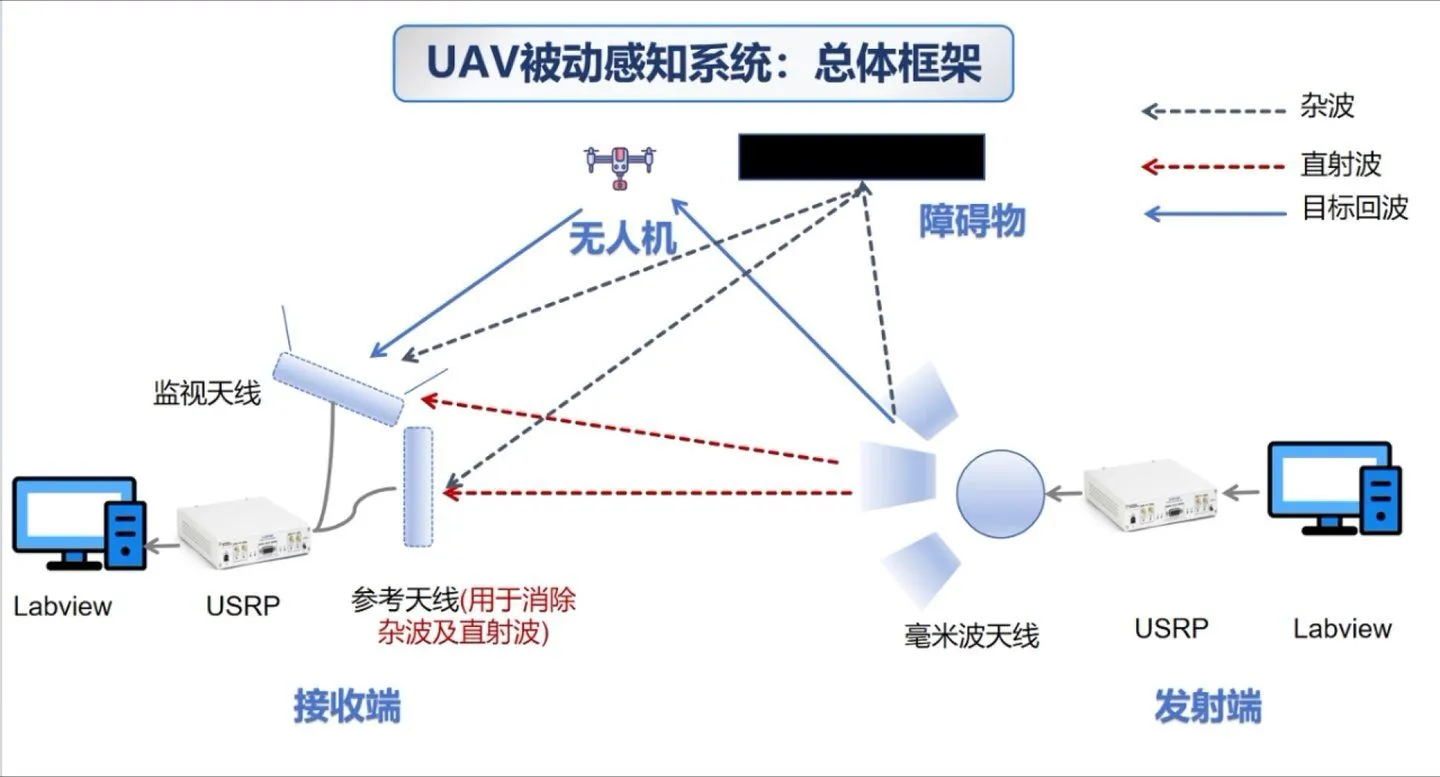
The lab has built a UAV passive sensing testbed with a mmWave antenna and USRP software-defined radios. A reference antenna is used to cancel the direct-path signal and clutter, and the system is used to validate passive detection of low-altitude targets.